Why status codes matter
The code itself arrives in the status line, while the details come in the HTTP headers. From it the client knows what to do next: render the page, follow a new address or report an error. For example, a successful response to a GET is 200 OK, and after a POST that creates a resource the server returns 201 Created.
The five code classes
The first digit sets the class of the response:
- 1xx — informational: the request was received and processing continues.
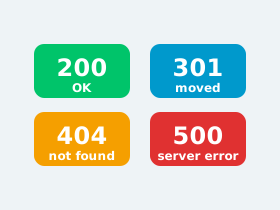
- 2xx — success: 200 OK, 201 Created, 204 No Content.
- 3xx — redirection: 301 (permanent) and 302 (temporary).
- 4xx — client error: 404 Not Found, 403 Forbidden, 401 Unauthorized.
- 5xx — server error: 500 Internal Server Error, 502 Bad Gateway, 503 Service Unavailable.
A 5xx code is often returned by a reverse proxy when the application behind it is unavailable, while 3xx redirects are commonly used to move a site onto HTTPS.