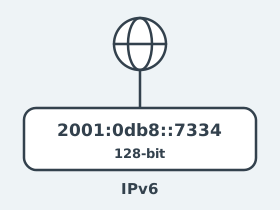
How an IPv6 address is built
An IPv6 address is written as eight groups of 16 bits in hexadecimal, separated by colons, for example 2001:0db8:85a3::8a2e:0370:7334. Consecutive groups of zeros can be shortened to a double colon "::". In total the IPv6 space holds about 3.4×10³⁸ addresses — enough for any network of the foreseeable future.
IPv6 and DNS
For a domain to be reachable over IPv6, it needs the matching record in DNS:
- AAAA record — maps an IPv6 address to a domain, just as the A record maps IPv4.
- Dual stack — a domain usually has both A and AAAA records so the site opens over both IPv4 and IPv6.
- Choosing the address — when the browser makes a request, DNS returns both addresses and the client uses whichever protocol is available.
This is how IPv6 gradually replaces IPv4 while staying compatible with the existing domain infrastructure.